Matthew 21:18—22:14
Ministries > Thru the Bible with Dr. J. Vernon McGee
https://www.oneplace.com/ministries/thru-the-bible-with-j-vernon-mcgee/
Facebook Twitter Instagram YouTubeEveryone is uncomfortable when people pretend they’re better than they are. Jesus hated hypocrites more than any of us. Throughout His ministry, He called out the hypocrites in the religious elite. Find out what bothered Him most about people who pretended to love God.
References
Steve Schwetz: You know why I'll never be a Christian? It's all those hypocrites. Well, you've probably heard that before, but do you know who hated hypocrisy even more? It was Jesus. Throughout His ministry, He called it out, especially among the religious elite. And that's where we're going to be headed today on Thru the Bible with our teacher, Dr. J. Vernon McGee. I'm Steve Schwetz, welcoming you aboard the Bible Bus as we continue our journey through the Gospel of Matthew. Now, as you find your seat, listen to how God's Word is at work in the lives of some of our fellow listeners this time in Cambodia. Sophan tells us this: "Your studies on the New Testament were extremely helpful to me when I was not yet familiar with God. Listening to these lessons deepened and strengthened my faith. They encouraged me to attend church and read the Bible for myself." And then Kim Lang shares this: "I tuned into the studies and found deep encouragement, even in the story of Job. It's teaching me patience in my daily work and relationships. This program has not only helped me understand the Bible better, it's changed my heart and given me a desire to study God's Word every day." Well, I love hearing that, don't you? And then here's what Sarah had to say: "I thank God for Thru the Bible. His Word has helped me understand truth more clearly and has deeply encouraged my heart. I've learned to be content. When I look at myself, I feel I have nothing, but when I look to God, I see He has everything. His Word is teaching me to listen, obey, love, and serve Him more faithfully. I'm so thankful. It has helped me love God more deeply." And then listen to this one from Net Om: "Each time I listen, the Word of God fills my heart with love, hope, and renewed strength. I truly thank God for pouring His love into my heart. Before knowing Him more deeply, I could not love others the way I do now. It is only through God's grace that I have learned to love my neighbor, even in difficult situations. Through these messages, I am constantly reminded that although we are all sinners, God still loves us deeply and unconditionally. This truth has changed my heart and the way I treat others." And that's what God's Word does, doesn't it? It reaches the heart and then it changes it from the inside out. Well, if you'd like to join us in interceding for listeners like these and for millions more in over 250 languages, then you need to sign up for the World Prayer Team over at ttb.org. And you know, we'd love to hear your story as well. So as you follow Jesus through Matthew, if you've found yourself maybe pausing at a fresh glimpse of who He is and what He's teaching you, would you let us know through the app? Or you can email us at [email protected], or call 1-800-65-BIBLE and just leave a message. You can also write to Box 7100, Pasadena, California, 91109. In Canada, Box 25325, London, Ontario, N6C 6B1. Let's pray. Heavenly Father, thank You for how the name of Jesus Christ is lifted up and Your Word is honored in Cambodia and around the world. Continue to carry Thru the Bible into places that we may never see. Reach Your people with the good news of Jesus through this study. It's in His name we pray. Amen. Now turn to Matthew 21 as we make our way through the Bible with Dr. J. Vernon McGee.
Dr. J. Vernon McGee: Now today, our study brings us here in the 21st chapter of Matthew. And we're going to put in today at verse 18. We saw last time the so-called triumphal entry of the Lord. We saw that He came into Jerusalem three times. Now on that last time, in verse 18, we read: "Now in the morning as he returned into the city, he hungered. And when he saw a fig tree in the way, he came to it, and found nothing thereon, but leaves only, and said unto it, Let no fruit grow on thee henceforth for ever. And presently the fig tree withered away." Now there has been, of course, a difficulty here in attempting to interpret the fig tree. What does the fig tree represent? And I've heard all sorts of interpretations of this. However, I feel that the fig tree is symbolic of Israel. I think we'll find that again in the 24th chapter. And again in that chapter, why there's been a great deal of disagreement as to just what the fig tree really means. Now, at least we can say with a great deal of confidence that when the Lord came into the world, there was no fruit on the nation, only the outward leaves of that ritual of a lifeless religion. They went through the form, but they denied the power thereof. And this is what He condemned. We're going to see in the remainder of this chapter and the one that's coming up that there's no mistaking that He condemned this very religious system that God had given because they had turned it to nothing in the world but a dead, lifeless ritual. It had lost its vitality and its virility and was no longer accomplishing God's purpose. And I am of the opinion God will deal the same way with the organized church that has turned its back upon the person of the Lord Jesus Christ. Now, he cursed the fig tree. And again I say that I feel this is symbolic. Certainly He condemned the nation, and this nation was judged. Now notice as I read on here, verse 20: "And when the disciples saw it, they marvelled, saying, How soon is the fig tree withered away!" This to them was quite an amazing thing. Then in verse 21: "Jesus answered and said unto them, Verily I say unto you, If ye have faith, and doubt not, ye shall not only do this which is done to the fig tree, but also if ye shall say unto this mountain, Be thou removed, and be thou cast into the sea; it shall be done. And all things, whatsoever ye shall ask in prayer, believing, ye shall receive." Now our Lord very definitely here, as you can see, gives them a lesson on prayer. And they marvelled that this took place, that the fig tree was cursed. He tells them that their problem would be that they would not have faith that God could move in such a miraculous way. Now I don't think that, frankly, our business is cursing fig trees or removing mountains, literal literal mountains. I live here in Southern California, and right along the foothill of the Sierra Madre Mountains. To me, they're quite lovely. I've never grown tired of them. There's never been two days where they were alike, and I always enjoy looking at them. David said, "Shall I lift up mine eyes unto the hills?" Well, I think David meant that his help didn't come from there, and I've never looked up those mountains for help, but they are quite beautiful. But I've never wanted to move them. I feel like that there's something bigger than mountain moving, and there's something bigger than cursing fig trees. And that is to preach the Gospel of Christ and to give out the Word of God and to have the Spirit of God use it. That, my friend, is a miracle when these lips of clay can say something that the Spirit of God can take and transform lives. Now that's the kind of faith I want. And I must confess that sometimes I wonder how in the world can the Lord use this radio program. A psychology professor that is a friend of mine, he said, "Did it ever occur to you that maybe the reason you read the letters is just to bolster up your lack of faith?" Well, that could be. I wouldn't argue with the psychologist on that. All I'm saying is that what we need is faith to believe that God can and will use His Word. But I believe that the fig tree represents Israel. Now listen to these chief priests and to the religious authorities. Verse 23, I'm reading: "And when he was come into the temple, the chief priests and the elders of the people came unto him as he was teaching, and said, By what authority doest thou these things? and who gave thee this authority?" The religious rulers, you see, are becoming ugly and very hateful in their manner. They don't question what He's doing. Do you notice that? And if there had been any basis on which they could deny that He had done these things, they would have. They say, "Now we want to know on what authority you do it." Jesus answered and said unto them, "I also will ask you one thing, which if ye tell me, I in likewise will tell you by what authority I do these things." Now here's His question to them: "The baptism of John, whence was it? from heaven, or of men?" And they reasoned with themselves, saying, "If we shall say, From heaven; he will say unto us, Why did ye not then believe him? But if we shall say, Of men, we fear the people; for all hold John as a prophet." You see, our Lord immediately He put them on the horns of a dilemma. These religious rulers were attempting to put Him on the horns of a dilemma. And He said, "I'll tell you by what authority I do it." Not that they really wanted to know. They were trying to trap Him. But He said, "I'll tell you, but you'll have to tell me by what authority John the Baptist did it. Was it of heaven or of men?" And of course, if they had said of heaven, He'd said, "Well, I'm moved by the same authority that John does." You can very well realize they would not receive what He would say concerning the basis of His authority. They wouldn't accept John's authority from heaven. They won't accept His either. They're trying to trap Him. Now notice: "And they answered Jesus, and said, We cannot tell. And he said unto them, Neither tell I you by what authority I do these things." Now you can see there's a tenseness that's developing here. This parable now that's coming up, and we need to have this before us, it's a scathing denunciation of the religious rulers, and it places the publicans and harlots above them, and they could not ignore this charge of Jesus. I tell you, He's really moving in upon them. Now listen to this: "But what think ye?" My, this is tremendous. "What think ye? A certain man had two sons; and he came to the first, and said, Son, go work to day in my vineyard." "He answered and said, I will not: but afterward he repented, and went. And he came to the second, and said likewise. And he answered and said, I go, sir: and went not. Whether of them twain did the will of his father?" They say unto Him, "The first." Jesus saith unto them, "Verily I say unto you, That the publicans and the harlots go into the kingdom of God before you." Now this is something that for them was terrible. He's putting the publicans and harlots above them. And they are the other son. The son that said, "I'll go," but he didn't go. I can make application of that for today very easily. We have a great many people that have joined the church. They're religious. They think they're Christians, but they're not Christians. Friends, we're seeing a great many people listening to this program that are becoming Christians. They already were church members. And we're seeing so much of that in these days because many people are reaching out for reality today and they want something that they can hold onto in dire, dark, and desperate days. And we're in that period now. And if you're one of those and all you have is a religion that is just outward, may I say to you that you can do all these things, join the church and say yes, yes, yes to everything, but that doesn't make you a Christian, you see. A Christian is one that's had a transformation take place in his life. Old things are passed away and all things are become new. That's a child of God. If any man be in Christ, he's a new creation. That is the person we're talking about here, by the way. And the publicans and harlots, they knew they were sinners. They came in late. They wouldn't go at first; now they come in. And He receives them. Listen to the Lord now as He speaks in verse 32: "For John came unto you in the way of righteousness, and ye believed him not: but the publicans and the harlots believed him: and ye, when ye had seen it, repented not afterward, that ye might believe him." You see, they were just religious. That's all. Nothing had really happened on the inside. It was all exterior. Religion is an exterior decoration. The real thing is interior, and it really not only redecorates, it makes you new. Now will you notice He gives them another parable? He's not through with them. Before they could get out of earshot, He has another one for them. Verse 33 now: "Hear another parable: There was a certain householder, which planted a vineyard, and hedged it round about, and digged a winepress in it, and built a tower, and let it out to husbandmen, and went into a far country: And when the time of the fruit drew near, he sent his servants to the husbandmen, that they might receive the fruits of it." "And the husbandmen took his servants, and beat one, and killed another, and stoned another. Again, he sent other servants more than the first: and they did unto them likewise. But last of all he sent unto them his son, saying, They will reverence my son. But when the husbandmen saw the son, they said among themselves, This is the heir; come, let us kill him, and let us seize on his inheritance." This is the most poignant parable that He's given so far. And this really was one that would dig in upon them. And what He's saying here is this: it's the final warning to the nation Israel, to the religious rulers. Last of all, He sent unto them His son. Now the Son was right there giving them this parable. And they knew what He was talking about. He made it very clear. Now what are they going to do with this Son? He's telling them right now what's in their hearts, what they're planning to do to Him. "And they caught him," I'm reading verse 39, "and cast him out of the vineyard, and slew him. When the lord therefore of the vineyard cometh, what will he do unto those husbandmen?" They say unto him, "He will miserably destroy those wicked men, and will let out his vineyard unto other husbandmen, which shall render him the fruits in their seasons." Now this is really digging right down where these men live. He sends them back, you see, to the Old Testament for the analogy of the stone to Himself. And I'm reading now verse 42: "Jesus saith unto them, Did ye never read in the scriptures, The stone which the builders rejected, the same is become the head of the corner: this is the Lord's doing, and it is marvellous in our eyes? Therefore say I unto you, The kingdom of God shall be taken from you, and given to a nation bringing forth the fruits thereof." And I would like to call your attention to the fact that He's changed the expression from kingdom of heaven to kingdom of God here. And I think that He's using the larger word because what He's getting ready to do now is to include the Gentiles and anyone that will come to Him. He says the kingdom of God will be taken from you, given to a nation bringing forth the fruits thereof. And the church is that holy nation. Verse 44: "And whosoever shall fall on this stone shall be broken: but on whomsoever it shall fall, it will grind him to powder." The first part of that verse speaks of His first coming: whosoever shall fall on this stone shall be broken. If you come to Him, He is the rock on which the church is built. No other foundation can any man lay. If you come and rest on Him by faith, He'll save you. But if you don't, then you'll have to do with Him at His second coming. Why, He is the stone that Daniel said cut out without hands, and it shall smite the image. And here our Lord says He'll grind him to powder. "And when the chief priests and Pharisees had heard his parables, they perceived that he spake of them." They knew what He was talking about. And today, unfortunately, a great many don't seem to see that there's an application for themselves, especially those in the church. "But when they sought to lay hands on him, they feared the multitude, because they took him for a prophet." Now when you come over into chapter 22, these religious rulers have already determined that He is to die. They sought to lay hands on Him, but they are afraid of the multitude at this time. Now, the Lord actually moves right on, and this next chapter will continue this verbal clash that He has with the religious rulers. Chapter 22 is the end of that verbal clash. And you have here the parable of the king who made a marriage feast, and that's a continuation of the Lord Jesus' answer to the chief priests and elders that was begun in the last chapter. Now let's note that. "And Jesus answered and spake unto them again by parables, and said," this is verse 1 of Matthew 22, "The kingdom of heaven is like unto a certain king, which made a marriage for his son." I think this is one of the greatest parables that He gave for this day in which we live. "And sent forth his servants to call them that were bidden to the wedding: and they would not come. Again, he sent forth other servants, saying, Tell them which are bidden, Behold, I have prepared my dinner: my oxen and my fatlings are killed, and all things are ready: come unto the marriage." "But they made light of it." The Lord Jesus begins this by saying, you see, "And again the kingdom of heaven is like unto this." And He spoke unto them again by parables. And we find now that He resorts back to the expression kingdom of heaven, which He didn't use, if you notice, in the last two parables. But this parable parallels the parables in Matthew 13, and the emphasis here is upon how and why this age began, not upon the conclusion of the age. You find that in Matthew 13. Now will you notice He sent forth His servants to call them that were bidden to the feast. And who are those that were bidden? The lost sheep of the house of Israel. He'd sent His apostles to them, and the prophets had been the messengers back in the Old Testament. And again He sent forth servants. That's verse 4. But what did they do? Verse 5: "But they made light of it, and went their ways, one to his farm, another to his merchandise: And the remnant took his servants, and entreated them spitefully, and slew them." Now notice what He's saying here. This is a direct reference to the rejection of the Lord Jesus. Now verse 7: "But when the king heard thereof, he was wroth: and he sent forth his armies, and destroyed those murderers, and burned up their city." Now He'll go back to that in chapters 24. We find out about the destruction of Jerusalem in 70 AD by Titus the Roman when he came. And I think this is a direct reference to that. Verse 8: "Then saith he to his servants, The wedding is ready, but they which were bidden were not worthy." In other words, now the invitation is going out. This is a definite change in the method and manner of the message, and it refers to this present age where we are today. "Go ye therefore into the highways, and as many as ye shall find, bid to the marriage. So those servants went out into the highways, and gathered together all as many as they found, both bad and good: and the wedding was furnished with guests." You see, the invitation's gone out today. And notice though what happened. "And when the king came in to see the guests, he saw there a man which had not on a wedding garment." Now what is that wedding garment? The invitation is for everyone, but you see there's a danger of coming without meeting the demands of the King. And that wedding garment is the righteousness of Christ, which is absolutely essential for salvation, and it's supplied to all who believe. Listen to Paul in Romans 3:21 and 22: "But now the righteousness of God without the law," that is apart from the law, "is manifested, being witnessed by the law and the prophets; Even the righteousness from God which is by faith of Jesus Christ unto all and it comes down upon all that believe: for there's no difference." You'll have to have the wedding garment. And he saith unto him, "Friend, how camest thou in hither not having a wedding garment?" And he was speechless. And I hear some of these people they say they're going to take their chance before God and they're going to talk to Him when they get there. This fellow was speechless without that wedding garment, friends. Verse 13: "Then said the king to the servants, Bind him hand and foot, and take him away, and cast him into outer darkness; there shall be weeping and gnashing of teeth. For many are called, but few are chosen." You have to have the wedding garment. And that's up to you. The call has gone out to everyone, but you'll have to come on His terms. Now the enemy makes the final onslaught, the final attack upon Lord Jesus. You have the Herodians coming first. You have the Sadducees coming next, and finally the Pharisees come. And then the Lord questions these Pharisees and they try to get away from Him as quickly as He can. That marks the break. And then in chapter 23, we hear Him denounce them. Now the Herodians came with their particular problem and it had to do with paying tribute to Caesar. The Sadducees had a question about the resurrection and the Pharisees came concerning the great commandment of the law. Now we're going to see the marvellous way in which our Lord answered these men. May I say I consider this one of the proofs of His deity is the way He dealt with the enemy. We're going to see that next time. It's one of the most marvellous things that you can possibly see about our wonderful Lord. May God richly bless you, my beloved.
Steve Schwetz: You know, I love the way God's Word always honors God's Son, Jesus Christ. And this is also the mark of great teaching when Jesus is lifted up. I'm looking forward to our next study as we see how Jesus handles His enemy. You can read ahead in Matthew and I'll be sure to save you a seat on the Bible Bus. And reading ahead is a great way to get even more out of our studies together. If you'd like a reading schedule, you can find it anytime in our app. That's what I use, or at ttb.org. You can also request one by calling 1-800-65-BIBLE. And if you're on our newsletter mailing list, you'll receive it automatically every month, so be sure to sign up. I'm Steve Schwetz. For all of us at Thru the Bible, we're grateful for your company on the Bible Bus and for your partnership in taking God's whole Word to the whole world. Thru the Bible exists to take God's whole Word to the whole world, and we invite you to stand with us with your faithful prayer and financial support. Where will God's Word go today?
Related Episodes
Matthew 20:24—21:17
Wednesday, August 12
Matthew 19:14—20:23
Tuesday, August 11
Matthew 19:1-15
Monday, August 10
About Thru the Bible
Thru the Bible takes the listener through the entire Bible in just five years, threading back and forth between the Old and New Testaments. You can begin the study at any time. When we have concluded Revelation, we will start over again in Genesis, so if you are with us for five years you will not miss any part of the Bible.
Other Thru the Bible Programs:
Thru the Bible - Minute with McGee
Thru the Bible - Questions & Answers
Thru the Bible - Sunday Sermon
About Dr. J. Vernon McGee
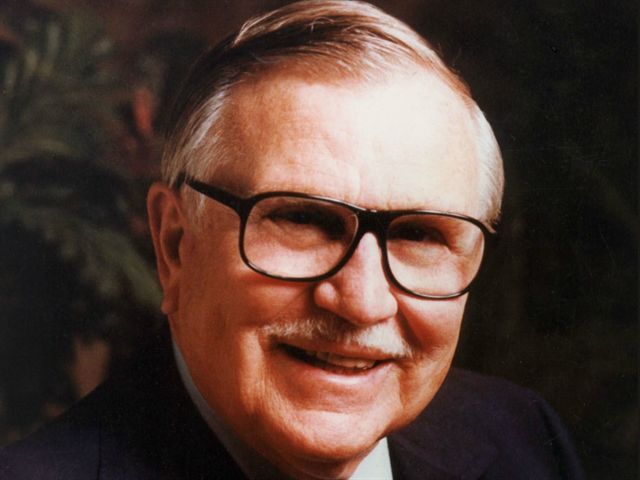
John Vernon McGeewas born in Hillsboro, Texas, in 1904. Dr. McGee remarked, "When I was born and the doctor gave me the customary whack, my mother said that I let out a yell that could be heard on all four borders of Texas!" His Creator well knew that he would need a powerful voice to deliver a powerful message.
After completing his education (including a Th.M. and Th.D. from Dallas Theological Seminary), he and his wife came west, settling in Pasadena, California. Dr. McGee's greatest pastorate was at the historic Church of the Open Door in downtown Los Angeles, where he served from 1949 to 1970.
He began teaching Thru the Bible in 1967. After retiring from the pastorate, he set up radio headquarters in Pasadena, and the radio ministry expanded rapidly. Listeners never seem to tire of Dr. J. Vernon McGee's unique brand of rubber-meets-the-road teaching, or his passion for teaching the whole Word of God.
On the morning of December 1, 1988, Dr. McGee fell asleep in his chair and quietly passed into the presence of his Savior.
Contact Thru the Bible with Dr. J. Vernon McGee
Mailing Address
Thru the Bible, Inc.
P.O. Box 7100
Pasadena, CA 91109
In Canada:
Box 25325,
London, Ontario
N6C 6B1
Phone Number
(626) 795-4145 or
(800) 65-BIBLE (24253)


