What would ‘concealed carry reciprocity’ mean for states with tighter gun laws?
Trending News

Audio By Carbonatix
10:30 AM on Wednesday, December 17, 2025
By Chip Brownlee for The Trace, Stacker

What would ‘concealed carry reciprocity’ mean for states with tighter gun laws?
Over the last three decades, carrying concealed guns in public in the United States has become easier and easier. First, in the 1990s, states began to guarantee permits to anyone who could legally own a firearm. Then, beginning in the mid-2000s, states started removing permit requirements altogether.
Now, a majority of states — 29 as of 2025 — require no license to carry a loaded gun in public, a policy known as permitless carry. But what happens when a resident of one of those states wants to carry their handgun in one of the 21 states that does require a permit?
That led a reader to send in a question concerning concealed carry reciprocity, or when one state recognizes the concealed carry permits of another. The reader asked:
“If your state has decent laws, which Michigan where I live has (ok) gun laws, the constituents of my state still have to follow our state’s laws. But could someone from Louisiana come here and have the very lax laws of their state apply to them while visiting Michigan? Is it a race to the bottom?”
It’s a timely question. Congress may vote as soon as this month on a bill that would require national concealed carry reciprocity, effectively allowing the residents of those 29 permitless carry states to carry guns nationwide without a license. The Trace dives into the specifics of concealed carry reciprocity, and what a nationwide law — a longtime gun rights goal — would look like.
What is concealed carry reciprocity?
Concealed carry reciprocity refers to the patchwork of state laws, policies, and agreements that determine whether one state honors concealed carry permits from another state, allowing permittees to travel across state lines with their guns.
Importantly, “reciprocity” is often not mutual: Recognition of out-of-state permits varies widely, and many arrangements are unilateral rather than formal two-way agreements.
Some states adopt broad recognition — for example, North Carolina and the reader’s home state of Michigan recognize permits from any state.
Others condition recognition on comparable standards, including fingerprint-based background checks, mental health disqualifiers, age requirements, or live-fire training. For instance, Minnesota recognizes permits from 33 states whose requirements its attorney general has deemed similar to Minnesota’s.
From there, it can get even more complicated. Washington state — which won’t recognize other states’ permits if they don’t require mental health background checks, or if they issue permits to people under 21 — only recognizes 10 states’ permits, and of those, sometimes only honors enhanced permits that have stricter eligibility requirements like live-fire training.
At least 10 states, including California, Oregon, and New York, and the District of Columbia, do not honor any out-of-state permits.
How does permitless carry affect reciprocity?
Permitless carry both simplifies and complicates reciprocity. In the 29 states that have passed permitless carry, both residents and nonresidents can carry a concealed firearm without a permit. That means that if you are visiting one of those states, you don’t need a permit to carry as long as you aren’t prohibited from possessing guns under that state’s or federal laws.
For example, an Alabama resident doesn’t need to get a permit to carry in Mississippi or Georgia, and vice versa.
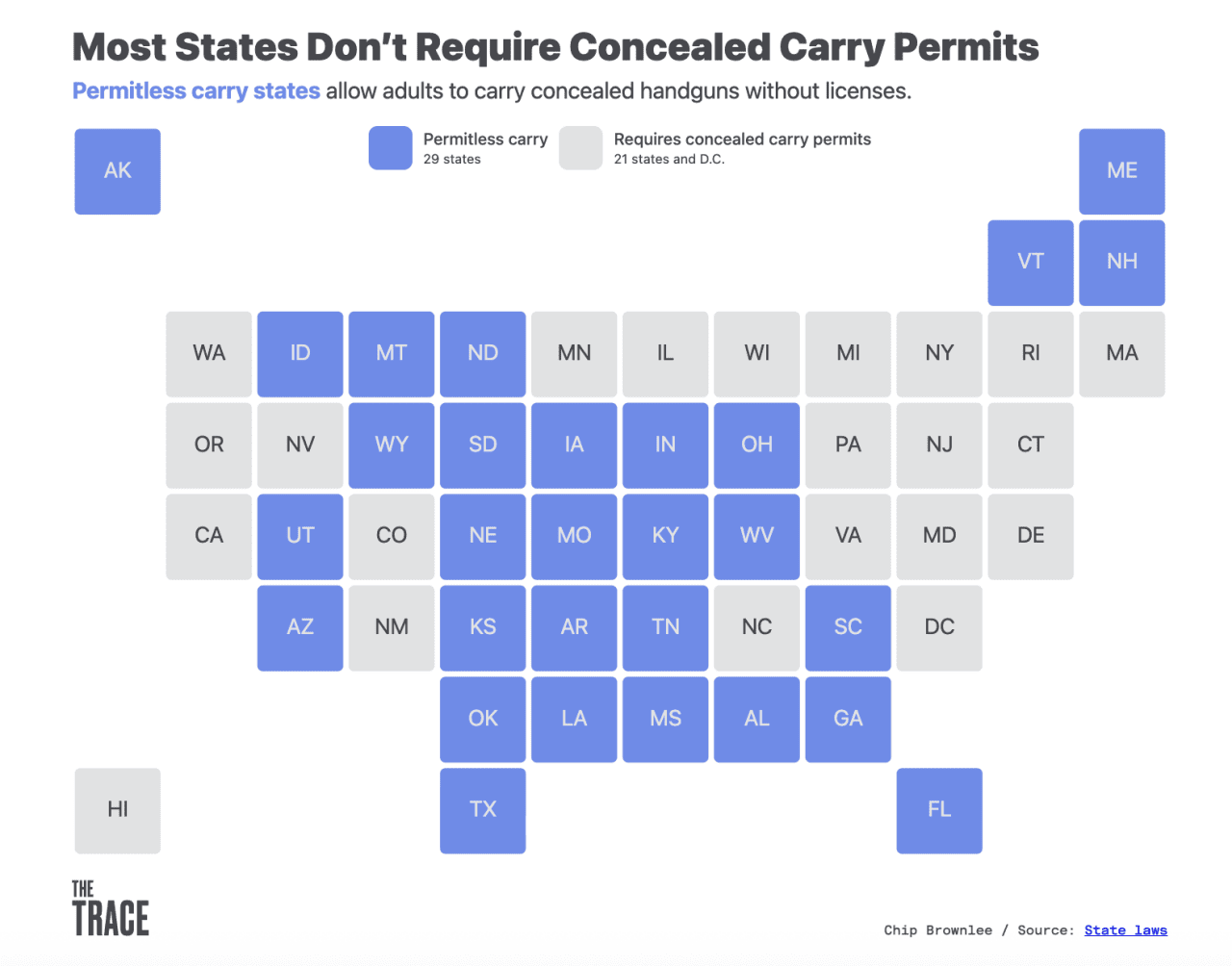
But the same is not true for residents of permitless carry states who want to carry in a state that requires a permit. In that case, you still need a license from your home state.
“Right now, in general, if you are from a state with permitless carry and you travel to a state that requires a permit, you still need a permit to carry,” said Alex McCourt, a professor at the Johns Hopkins Bloomberg School of Public Health and assistant director of the Center for Law and the Public’s Health. “Permitless carry doesn’t necessarily transfer.”
That’s why nearly all states that have permitless carry still provide a process to obtain a carry permit, and why many gun owners in permitless states still apply for them: to ensure they can legally carry when traveling or commuting to another state with reciprocity.
Is it a “race to the bottom”?
The reader who posed the question worried that reciprocity could mean the weakest state laws effectively override stronger ones. The reality is more complicated.
When it comes to carrying a gun, the laws of the state you’re carrying in apply. That means reciprocity is not a blanket permission slip. “Typically, the only thing that really transfers from state to state is recognizing the validity of the permit,” McCourt said. “For example, if Michigan says you can’t carry in certain locations, that applies to everybody carrying in Michigan — even if your home state doesn’t have those restrictions.”
To build on that example: Say a permit holder from Louisiana is visiting Michigan, which prohibits carrying guns in bars, churches, schools, day cares, and sports arenas or stadiums. Even though Louisiana doesn’t have all the same place-based restrictions, the Louisiana visitor would still need to follow Michigan’s rules while carrying in Michigan.
But when it comes to acquiring a gun, the laws of the gun owner’s home state generally apply. That’s where the “race to the bottom” concern comes in: A person from a state without universal background check requirements, like Louisiana, could purchase a gun in a private sale without a background check and still legally carry that gun in a stricter state like Michigan, where the same purchase would have required a background check had it been done there.
“Michigan couldn’t say, ‘You didn’t go through a background check, so you can’t have that gun here,’ because the person followed Louisiana’s rules when acquiring it,” McCourt said.
What would nationwide reciprocity look like?
For years, gun rights advocates and the gun industry have pushed for a federal law requiring all states to recognize one another’s permits — or lack thereof. Several bills have been introduced in Congress, including the Constitutional Concealed Carry Reciprocity Act. If passed, it would bar states from fully enforcing their laws on gun carrying. The consequences would be sweeping.
The legislation would allow any person who is licensed or “entitled” to carry a concealed firearm in one state to carry a concealed handgun in any state. As written, the bill appears to go beyond mandating that states honor other states’ permits. It would also effectively create nationwide permitless carry for people whose home states have such laws on the books.
“What I understand from this bill is that if you are in a state that allows an individual to carry a concealed weapon without a permit, you will then be permitted to carry a concealed weapon without a permit in every state in the country,” U.S. Representative Dan Goldman, a Democrat from New York, said during a committee hearing on the bill in March.
Goldman pointed to an analysis from The Trace that showed that states that have enacted permitless carry saw violence increase after the bills went into effect. “Now essentially the entire country will become a permitless country,” he said.
While there isn’t research directly measuring the effects of reciprocity itself, the evidence on loosening concealed carry requirements generally is fairly consistent, said Cassandra Crifasi, a researcher and co-director of the Johns Hopkins Center for Gun Violence Solutions.
“Everything we know about what happens in states when they’ve removed permitting requirements — whether it’s violent crime, shootings, shootings by police, any of those sorts of things,” Crifasi said, “the best evidence suggests that those things would go up and therefore make everyone less safe.”
Critics also warn the bill would undermine the remaining training and licensing systems in states with stricter laws like New York, New Jersey, or Massachusetts. “Many states that require a permit also require you to get training,” McCourt said. “Nationwide reciprocity could neuter those training requirements nationwide.”
Proponents often compare national concealed carry reciprocity to driver’s licenses. But Crifasi said the similarities are only superficial.
“With driver's licenses, you have to take a vision test and a written test, and then you have to pass a proficiency test” that requires actually driving a vehicle, she said. But concealed carry permit requirements vary widely from state to state, with most not requiring live-fire training.
“We’re comparing apples and pineapples when you talk about concealed carry and a driver’s license, because in more than half of states now you don’t need to get a license at all,” Crifasi said. “That would be like saying, ‘Oh, you live in Texas and you don’t need a driver’s license? Cool, go drive in New York City without getting a driver’s license, no problem.’ It doesn’t logically track the same way.”
Could the law pass?
The bill has broad support among conservative lawmakers, with 189 Republican co-sponsors in the House. It already cleared a committee vote in March, and in October, it was placed on the House calendar, meaning it could be brought up for a floor vote at any time. President Donald Trump has pledged to sign it if it reaches his desk.
While it’s possible or even likely for the bill to pass the House, it faces a tougher challenge in the Senate, where it would need 60 votes — and thus Democratic support. No Democrats are likely to support the law.
Opposition from law enforcement may also peel off Republican support. In November, two of the nation’s largest law enforcement associations — the Fraternal Order of Police and the International Association of Chiefs of Police — came out against the bill, arguing that it could place officers in both legal and physical danger. “Officers would be expected to interpret and apply laws from all 50 states in real time, without reliable means to verify an individual’s eligibility to carry concealed weapons, especially those from permitless carry states where no physical permit exists,” the groups wrote in a joint statement.
The legislation allows lawsuits against officers and agencies for arrests or detentions that violate its provisions. That could make it difficult for police to enforce concealed carry laws at all, since an officer could be placing themselves in legal jeopardy if they take any action — like temporarily securing a firearm during questioning — that could later be construed as violating a person’s concealed carry rights.
That legal ambiguity, plus incentivizing more frequent gun toting in more places, could place officers in danger. “This leaves law enforcement unable to confirm lawful possession during encounters, creating confusion and heightened risk in high-stakes situations,” the law enforcement groups wrote.
Still, gun rights groups are pressuring Republicans to prioritize the bill despite law enforcement opposition. “‘Shall not be infringed’ does not just apply to law enforcement – it is the God-given, constitutionally protected right of the People,” the Gun Owners of America wrote in a November 25 letter to House Speaker Mike Johnson responding to the law enforcement opposition.
Even if the bill doesn’t pass, gun rights proponents are also working in the courts. The Supreme Court could soon decide whether it takes a case from Massachusetts in which a New Hampshire plaintiff is challenging Massachusetts’s permit requirements for nonresidents. In September, New Hampshire and 24 other states urged the justices to take the case. Should the court agree and strike down the law, it could imperil similarly strict laws in other states and expand interstate gun carrying nationwide.
The bottom line
Reciprocity today is a patchwork. Some states recognize many permits, others only a few, and permitless carry doesn’t automatically transfer across state lines. But a federal reciprocity law or a broad ruling from the Supreme Court could dramatically expand where people can carry — and, experts warn, weaken training and safety standards across the country.
“It’s supposed to make things simpler,” McCourt said, “but in reality it could be more confusing — and more dangerous.”
This story was produced by The Trace and reviewed and distributed by Stacker.


