Exodus 1
Ministries > Thru the Bible with Dr. J. Vernon McGee
https://www.oneplace.com/ministries/thru-the-bible-with-j-vernon-mcgee/
Facebook Twitter Instagram YouTubeWhen we left God’s people at the end of Genesis, just 70 members of Joseph’s family lived in Egypt. Turn the page and 350 years have gone by and now God’s people—likely a couple million strong—are slaves . . . but not for long. God didn’t forget His people but promised to send them a deliverer. And that’s a story worth our attention as we watch God prove Himself over and over.
References
Steve Schwetz: Welcome to Thru the Bible, with our teacher Dr. J. Vernon McGee. We're glad you're here as we begin a journey through a book that Dr. McGee nicknamed "the great redemption story." That's right, we're back in the Old Testament, ready to travel through the book of Exodus. And we're heading down to Egypt at a time when God's word says that Pharaoh forgot about Joseph and forgot that the Israelites were God's people. And God's people even wondered if God himself had forgotten them. But he hadn't, of course; God had a rescue plan. That's all ahead for us here on the Bible Bus. So hop aboard, and as you find your place in Exodus, let's lean across the aisle and listen to what God is doing in the lives of our fellow riders.
Megan: Hi, this is Megan from Fort Worth, and I listen to the Bible story on 91.3 FM anytime, every time I'm in the car and even have the TuneIn radio app to listen to 91.3. I'm working 12 to 15-hour days and just want to thank you guys for the gospel and teaching lessons that are easy to digest and understand and something that's convenient to where I can listen when I'm driving because I don't have a lot of free time. It's really expanded on my knowledge and my closeness with God and I just want to thank you guys for broadcasting every day. God bless you.
Steve Schwetz: It's great to have you aboard, Megan. Thanks for calling in. And here's another voicemail from a listener who didn't leave his name.
Guest (Male): I first heard Pastor McGee in 1975 when I was in the penitentiary for a violent crime. I listened and listened and listened. I was raised in the church. Now I am 82 years old and I'm still on the Bible Bus. It's been an up and down road, amen, but I'm still on the Bible Bus. Thank you, Jesus. Bye-bye.
Steve Schwetz: Well, thanks for your decades with us. I'll continue to save you a seat. Our last note is from a listener named Veeman, and he writes, "I'm so thankful for the Bible Bus. In October of 1994, I gave my life to Jesus. At the time, I was driving a dump truck for a swimming pool company and it only had an AM radio. I took my lunch at 12:00 p.m. and I found the Bible Bus. I hopped on and never looked back. The teaching was a blessing from God. I was a beginner and Dr. J. Vernon McGee shared his wisdom. Truly blessed me and gave me direction. Brother Steve, it has been a blessing to also listen to your godly wisdom. Now, when I'm unable to catch you on the radio, I'm blessed to have the app. Thank you for being there at the beginning of my walk with Jesus." What a great story. I love to hear about how listeners take their lunch with Dr. McGee. What a terrific way to focus on God throughout the day. And what about you? When and where are you listening? Even right now, what are you learning as well? Have you been with us maybe a month, a year, a decade? You know, we'd love to know that as well. You can drop us a note super easy. You can do it in our app. You can email us as well at [email protected] or just write to Box 7100, Pasadena, California, 91109 or in Canada, Box 25325, London, Ontario, N6C 6B1. Or like these friends that we heard from today, call 1-800-65BIBLE and leave a message. Let's pray. Thank you, Father, that your will is for all of us to hear and respond to your offer of life and forgiveness. Thank you for meeting us in our need and then drawing us closer as we study your word together. In the name of our Savior and your Son, Jesus, we pray. Amen. Let's head over to Exodus 1 as we go through the Bible with Dr. J. Vernon McGee.
Dr. J. Vernon McGee: Now the book of Exodus, friends, is a book where it continues the account that was begun in Genesis. As someone has said, nothing is begun in Exodus and nothing is concluded in Exodus. It just continues the account. Actually, there is a break, however, of three and a half centuries. You remember back in Genesis 15:13, God had said to Abraham that they would spend 400 years in Egypt. Now over in Exodus 12:40, it says it was 430 years. And of course, the critic always likes to point out little things like that and find an error in the Bible, a contradiction. Well, actually, if you turn over to Galatians 3:16 and 17, you'd find out that the Exodus date is confirmed. But you'd note there, it was 430 years from the call of Abraham and it was 400 years from the time that God told Abraham what would happen to his offspring. You see, he didn't give him that at first. But I do want to add this rather hastily, that it's difficult to be dogmatic about the chronology of the patriarchal period. That is, when you get back that far, it's very difficult to date it. They didn't have calendars back then and they didn't feel it was as important as we seem to think it is today, the dates. Now we've omitted, if you'll notice, all dates in these outlines. And the reason for that is that the books of the Pentateuch, I do not think that we ought to attempt to be dogmatic about dates, and therefore I do not want to put it down in black and white. Now this book of Exodus opens with the children of Israel in Egyptian bondage. In fact, chapter one, we find Israel in Egyptian bondage. Three and a half centuries have gone by and they came down there just a little group, actually. We're told here in verse five, "And all the souls that came out of the loins of Jacob were seventy souls: for Joseph was in Egypt already." And that out of these seventy, why it probably went up to two million one hundred thousand. Now when I get to the book of Numbers, I'll go into detail of why we assume that it was that number. In fact, that happens to be the numbering that Dr. Melvin Grove Kyle, one of the great Egyptologists of the past—he was the editor of National Geographic and of this ponderous set of books called the International Standard Bible Encyclopedia—he was a great archaeologist, by the way. I had the privilege of studying under him and he gives the figure of two million one hundred thousand that went out of Egypt, and seventy went down. So you see, when God said that he would multiply the seed of Abraham, God really did it. He made good. I think that you need to put with the book of Exodus the passage back in the 46th chapter of Genesis, beginning with verse two, the two verses there. And I'd like to read these because this gives us the background. And it says, "And God spake unto Israel in the visions of the night, and said, Jacob, Jacob. And he said, Here am I. And he said, I am God, the God of thy father: fear not to go down into Egypt; for I will there make of thee a great nation." Now when the book of Exodus opens, that promise of God has been made good. Here are these people down there, two million one hundred thousand, and that, by the way, is a minimum. It could not have been less than that. Personally, I think it could have been twice that number. Some think it was five million came out of the land of Egypt. And again, regardless of the number, down in that land they became a great nation, but under most adverse circumstances and difficulties as we shall see as we get into this book. The man now that comes before us is actually the author of the Pentateuch, the man who wrote Genesis, Exodus, Leviticus, Numbers, and Deuteronomy. These first five books of the Bible are called the Pentateuch, and Moses is the author. They are called the Mosaic system or the Mosaic law, he being the author of these books. And you're well aware, I'm sure, that the critic today assumes there were many authors, not just Moses. And that's been batted around since the days of the Graf-Wellhausen hypothesis that came out of Germany, you see. That came out before Nazism came out of Germany. It's interesting that when men give up the Bible, they take on some very peculiar philosophies. But that was part of the rejection. We still take the position that Moses is the author of the first five books of the Bible and there's good evidence that that is accurate. And therefore, we're going to have Moses come before us in this book as he does in no other book. And you find his life divided into three 40-year periods: the first 40 years in Pharaoh's palace in Egypt, and then 40 years on the back side of the desert in Midian, and then 40 years in the wilderness as the leader of Israel. We'll go into that, of course, when we get to it. These are some of the things that are going to be before us as we get into this book of Exodus. Now with that in mind, let's come to this chapter where we see Israel in Egyptian bondage. And I'd like to begin reading at chapter 1, verse 1 of Exodus. "Now these are the names of the children of Israel, which came into Egypt; every man and his household came with Jacob." Then you have the names given: Reuben, Simeon, Levi, and Judah, Issachar, Zebulun, and Benjamin, Dan, and Naphtali, Gad, and Asher. "And all the souls that came out of the loins of Jacob were seventy souls: for Joseph was in Egypt already." And now we have here just the continuation with the lapse of the three and a half centuries, you see. The word that is translated here "now these are the names" could just as easily be translated "and"—"and these are the names." In other words, the conjunction "and" would tie it back to Genesis and then would move ahead. And we have therefore, I think, a better word just to put it, "and these are the names" of the children of Israel. Now if we're talking about grammar, why I'm sure it would be better to say "now these are the names." Either one would be accurate, but "and" I think really gives the meaning here, and that is the thing we're emphasizing. And you notice, seventy souls went down into Egypt. Now we're told in verse six, "And Joseph died, and all his brethren, and all that generation." We had in the conclusion of the book of Genesis the death of Joseph. But now we have the record here that all his brethren died, all that generation. So now three and a half centuries go by and what happens? "And the children of Israel were fruitful, and increased abundantly, and multiplied, and waxed exceeding mighty; and the land was filled with them." And remember now the verse I read back in the 46th of Genesis: God said that they would increase, they would multiply, and that they would become a great nation down in the land of Egypt. Now that has actually taken place. Now we come to the great change, verse eight: "Now there arose up a new king over Egypt, which knew not Joseph." Now a new Pharaoh comes to the throne and he never heard of Joseph. And Dr. Kyle, who knew that land—that is, the land of Egypt—and its history, says at this particular time, at the time of the Exodus, that what had happened was that there was a new dynasty that arose in Egypt. The Hyksos kings had been ruling. Now the Hyksos kings had come from out in the desert. They were nomads, Bedouin tribes, and actually related to the Israelites. And that is probably the reason that the Pharaoh in Egypt at that time was so willing to bring Joseph into such close proximity to him in ruling the land of Egypt. After the Hyksos kings, the old dynasty was able to drive out the Hyksos kings and now the Egyptians, regular Egyptians, they came to the throne again. And there arose now a king; he never knew this man Joseph, nor did he feel any indebtedness to him at all. You could understand that the others would, but not the new line. In fact, he would be in direct opposition to it. And we find here this statement, and it is a sad statement in a way: "There arose up a new king over Egypt, which knew not Joseph." There is something that we need to keep in mind as a tremendous lesson here. I've often wondered why these movements today who specialize in reaching children have not used this verse. It should be used. There is a continual and a continuous responsibility of teaching the word of God to each generation. Because if you don't, why the time will come when they'll forget all about you. I've used this illustration before about the Coca-Cola man in Texas that told me, I forget how much of a bottle of Coca-Cola, a certain percent, goes for advertising. He said that that is essential. And I was kidding him; I found 13 advertisements, 13 signs on the square in the little town I was in in Texas, and every one of them was a Coca-Cola sign. I said, "That's overdoing it." He said, "Not so," and he mentioned Arbuckle coffee. He said, "When's the last time you saw a can of Arbuckle coffee?" and I said, "Well, I remember as a boy it was quite popular." Well, he said it was, but they thought they didn't need to advertise. There arose in Egypt a Pharaoh who knew not Joseph. I was really shocked not long ago when my own daughter and my son-in-law were talking to me, and they had no knowledge of the Depression. Now I should have been aware of that, but I actually was not aware. I mentioned something about how difficult it was during the Depression. Well, they weren't even around at that time. There's a new generation. And I think that part of the generation gap today is because a lot of these kids don't understand what some of us older folk went through. There's always a new generation coming on that never heard about the Lord Jesus Christ. And therefore, it's always necessary to teach the next generation. And so there arose a generation never heard of Joseph and at one time he was a hero; they couldn't even remove his body out of the land. Now we're told here that this new Pharaoh that arose, he said unto the people—and this is verse nine—"Behold, the people of the children of Israel are more and mightier than we: Come on, let us deal wisely." Well, his idea of dealing wisely is the wisdom of the world. And he says, "Lest they multiply, and it come to pass, that, when there falleth out any war, they join also unto our enemies, and fight against us, and so get them up out of the land." That was a possibility, of course, and they did present a real problem, I'm sure, to this Pharaoh. But he's using worldly wisdom to solve it. The simple matter would be to let them go, and that would solve it. But he wants them as slaves, of course. We're told here at verse 11, "Therefore they did set over them taskmasters to afflict them with their burdens. And they built for Pharaoh treasure cities, Pithom and Raamses." That was something that reveals now that they were those that were really doing hard work. Actually, some have thought that they had something to do with the building of the pyramids. Well, I think the pyramids probably were there long before this. But certainly the city of Raamses has been excavated, and I remember Dr. Kyle brought to class one day a brick that had been taken out of that city—the interesting thing, a brick that had been made without straw and it showed evidence of it. Then another brick that had evidence it was made with straw. So that the record that's given here is quite an accurate record. But it'd be accurate if they'd never found any bricks at all. The bricks here are not thrown at the Bible, however; they rather confirm it and that of course makes it interesting. They did build the cities of Raamses. Now we're told, "But the more they afflicted them, the more they multiplied and grew. And they were grieved because of the children of Israel." Now they're put in a pretty hard spot as you can see down here in the land of Egypt. And this is exactly what God had told Abraham would happen. Now back in the 15th of Genesis, verse 13, God had said, He said unto Abram, "Know of a surety that thy seed shall be a stranger in a land that is not theirs, and shall serve them; and they shall afflict them four hundred years." Now three things: they're to be a stranger in a strange land, and they are there to be servants—that is, slaves—and they shall afflict them. So that these three things are all fulfilled right here and we're just about a dozen verses in the first chapter here. Now we're told though the more they afflicted them, the more they multiplied and grew. Verse 13: "And the Egyptians made the children of Israel to serve with rigour: And they made their lives bitter with hard bondage, in mortar, and in brick, and in all manner of service in the field: all their service, wherein they made them serve, was with rigour." In other words, they are not only making them slaves, but they are mistreating them. Now the king of Egypt spake to the Hebrew midwives, of which the name of the one was Shiphrah, and the name of the other Puah. I was very much interested to see the meaning of these two women, and the name of the first is "beauty" and the name of the second one "splendor." Splendor and beauty. Have you ever noticed the silhouette pictures of Egyptians? Do these two names here grab you, my friend, when you think of those silhouettes and the pictures of the Egyptian women? Beauty and splendor, that is the thing that characterized the women in the land of Egypt. And these two apparently were women that are in official positions, a high position, and they had charge—in fact, they're the head of the nurses in the land of Egypt. They are the ones that would have charge in bringing the little ones into the world. Verse 16: Now this is the king of Egypt or the Pharaoh speaking. He said, "When ye do the office of a midwife to the Hebrew women, and see them upon the stools; if it be a son, then ye shall kill him: but if it be a daughter, then she shall live." Now this is another attempt of Satan to destroy the line that's leading to the Lord Jesus Christ. Now friends, you're going to find that this goes all the way through the Bible, the Old Testament right into the New Testament. You will find out that several attempts were made to destroy them, to exterminate them. And it's quite interesting the way that anti-Semitism has spread throughout the world. It's something that you don't seem to be able to kill it out. It's satanic in its origin and therefore no child of God today, no Christian, could possibly have any part in anti-Semitism. It's generally the godless that have persecuted them and the non-Christian. Now I know someone's going to say during the Dark Ages the church engaged in it. Yes, but it was the Dark Ages, you remember. They were very far from the word of God. There was a great deal in externalities in religion. My firm conviction is that no person can study the word of God and become anti-Semitic. This is a satanic attempt to get rid of the children of Israel. But notice how God always intervenes. Verse 17: "But the midwives feared God." In other words, these people had borne a witness in the land of Egypt and at least the midwives that had come in contact with the people, they feared God, "and did not as the king of Egypt commanded them, but saved the men children alive. And the king of Egypt called for the midwives, and said unto them, Why have ye done this thing, and have saved the men children alive? And the midwives said unto Pharaoh, Because the Hebrew women are not as the Egyptian women; for they are lively, and are delivered ere the midwives come in unto them. Therefore God dealt well with the midwives: and the people multiplied, and waxed very mighty." In other words, this attempt to destroy all the male children just wasn't coming off very well in the land of Egypt. This is another political maneuver that didn't work out, and believe me, there's been many a political maneuver in our day that hasn't worked out. Verse 21: "And it came to pass, because the midwives feared God, that he made them houses." In other words, these two women apparently had charge of them and they became a group that was greatly respected in the land. Now the last verse, verse 22 of chapter 1: "And Pharaoh charged all his people, saying, Every son that is born ye shall cast into the river, and every daughter ye shall save alive." Now you see this would soon exterminate them as a race. And the question is: is it going to succeed or work? And the fact of the matter is, I think we can already say it will not. Now we'll see next time the birth of the deliverer, that is the birth of Moses whom God will raise up to deliver the children of Israel out of Egyptian bondage. This is the great book on redemption. It reveals in actual picture form of how God today delivers us from sin and from the world and the flesh and the devil and saves us for heaven, for these people are to be brought into the land later on. So until next time, my beloved, may God richly bless you.
Steve Schwetz: Well, we're just getting started in this wonderful stretch of God's word and there's room for more on the Bible Bus, so if someone comes to mind, why don't you invite them to join us? Call 1-800-65BIBLE and request a pack of Bible Bus passes. Each one of them has got a little QR code that takes them straight to our study. One small card could open the door to a life-changing journey and you could be a part of it. And when you invite them, mention that Dr. McGee's notes and outlines are also provided for free in our app or online. Just look for our free digital book *Briefing the Bible*. It's got all of Dr. McGee's notes and outlines on Exodus and our entire five-year study of God's word. Again, download it for free right from our app or go to ttb.org. And if you prefer we send you an abbreviated paperback copy by mail, well, we got you covered. Just call us: 1-800-65BIBLE. Again, that's 1-800-65BIBLE or send us a note in our app or email [email protected]. I'm Steve Schwetz and I'll be sure to save you a seat as the Bible Bus rolls along.
Related Episodes
Matthew 27:50—28:20
Wednesday, August 26
Matthew 27:1-50
Tuesday, August 25
Matthew 26:23-75
Monday, August 24
About Thru the Bible
Thru the Bible takes the listener through the entire Bible in just five years, threading back and forth between the Old and New Testaments. You can begin the study at any time. When we have concluded Revelation, we will start over again in Genesis, so if you are with us for five years you will not miss any part of the Bible.
Other Thru the Bible Programs:
Thru the Bible - Minute with McGee
Thru the Bible - Questions & Answers
Thru the Bible - Sunday Sermon
About Dr. J. Vernon McGee
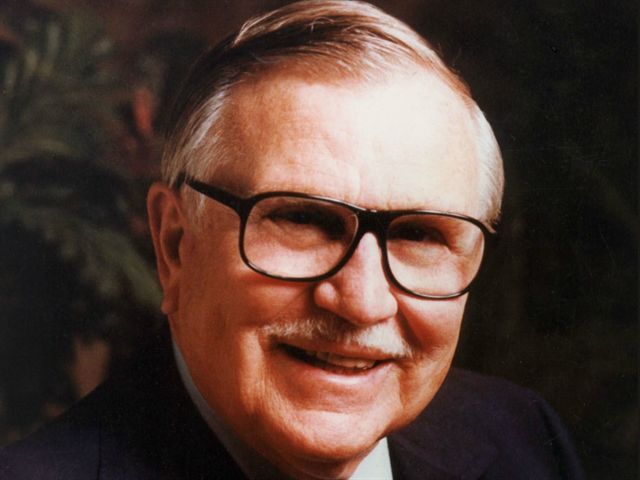
John Vernon McGeewas born in Hillsboro, Texas, in 1904. Dr. McGee remarked, "When I was born and the doctor gave me the customary whack, my mother said that I let out a yell that could be heard on all four borders of Texas!" His Creator well knew that he would need a powerful voice to deliver a powerful message.
After completing his education (including a Th.M. and Th.D. from Dallas Theological Seminary), he and his wife came west, settling in Pasadena, California. Dr. McGee's greatest pastorate was at the historic Church of the Open Door in downtown Los Angeles, where he served from 1949 to 1970.
He began teaching Thru the Bible in 1967. After retiring from the pastorate, he set up radio headquarters in Pasadena, and the radio ministry expanded rapidly. Listeners never seem to tire of Dr. J. Vernon McGee's unique brand of rubber-meets-the-road teaching, or his passion for teaching the whole Word of God.
On the morning of December 1, 1988, Dr. McGee fell asleep in his chair and quietly passed into the presence of his Savior.
Contact Thru the Bible with Dr. J. Vernon McGee
Mailing Address
Thru the Bible, Inc.
P.O. Box 7100
Pasadena, CA 91109
In Canada:
Box 25325,
London, Ontario
N6C 6B1
Phone Number
(626) 795-4145 or
(800) 65-BIBLE (24253)


